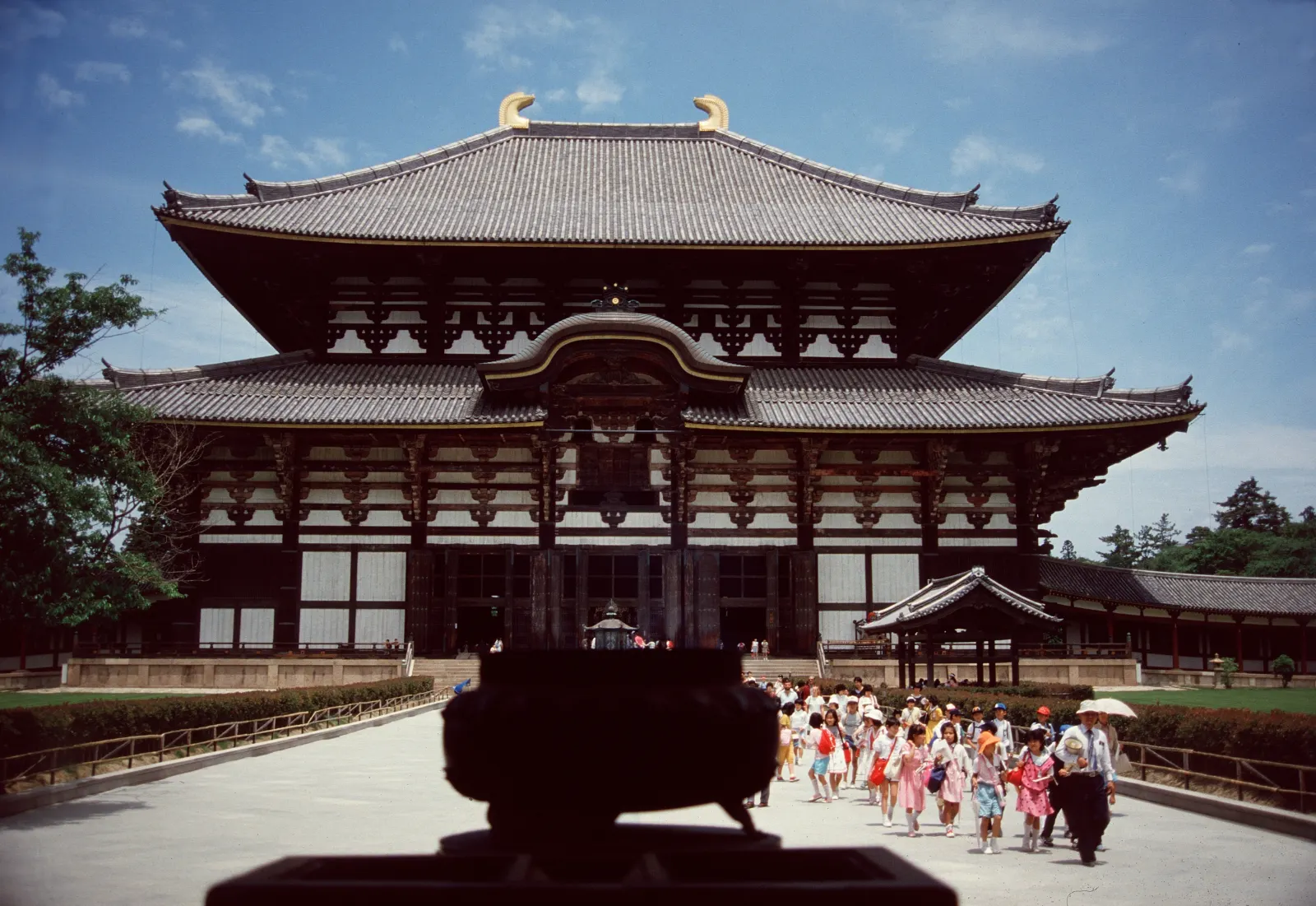

Japan’s history in five chapters
| Period | Years | Where to feel it |
|---|---|---|
| Nara | 710–794 | Todai-ji and its Great Buddha (dedicated 752), Kasuga Taisha |
| Heian | 794–1185 | Kyoto founded as Heian-kyo; Byodo-in in Uji (1053) |
| Kamakura and Muromachi | 1185–1573 | Kamakura’s Great Buddha; Kinkaku-ji (1397) and Ginkaku-ji in Kyoto |
| Warring states and Edo | 1573–1868 | Himeji Castle; Nijo Castle in Kyoto (1603); the Tokugawa shoguns |
| Meiji and modern Japan | 1868– | The capital moves to Tokyo; Meiji Jingu; Hiroshima’s Peace Memorial |
Nara: Japan’s first great capital
In 710, the court settled at Heijo-kyo, today’s Nara. Buddhism was the new state religion, and Emperor Shomu ordered a giant bronze Buddha, dedicated in 752 at Todai-ji. Mario explains why the emperor built it, how the bronze was cast, and why the hall you see today, though rebuilt, is still one of the largest wooden buildings in the world.
Heian: the court of poets
In 794 the capital moved to Heian-kyo, today’s Kyoto, laid out in a grid copied from China. For four centuries aristocrats wrote poetry, perfected etiquette and produced The Tale of Genji. At Byodo-in in Uji, built in 1053 and pictured on the ten-yen coin, Mario shows how nobles imagined paradise.
Samurai and shoguns
From the 12th century, warriors took real power. Shoguns ruled from Kamakura, then from Kyoto, where Kinkaku-ji, the Golden Pavilion, was built as a retirement villa in 1397. After a century of civil war, three unifiers ended the fighting, and in 1603 Tokugawa Ieyasu founded the Edo shogunate. At Nijo Castle, Mario walks you over the “nightingale floors” that squeak to warn of intruders.
Edo: peace for 250 years
The Tokugawa shoguns kept Japan largely closed and at peace from 1603 to 1868. Merchant culture flourished: theater, woodblock prints, tea. Himeji Castle, completed in its current form in 1609, survives from this age. In Kyoto’s Gion and Higashiyama, the wooden townhouses still reflect the merchant city.
Meiji: Japan opens to the world
In 1867 the last shogun returned power to the emperor at Nijo Castle, and in 1868 the Meiji Restoration began. The capital moved to Tokyo, Japan industrialized at astonishing speed, and Kyoto reinvented itself with canals and the Heian Shrine. In Tokyo, Meiji Jingu honors the emperor who led that transformation.
Stories, not dates
Few travelers remember dates, but everyone remembers a good story: the monk who carried a statue to Kiyomizu’s hillside, the shogun who built Kinkaku-ji covered in gold leaf, the merchants who donated torii at Fushimi Inari for success in business. Mario tells history the way you would tell it to a friend, linked to what you can see in front of you, and answers questions as they come. Children and teenagers enjoy it too, especially the samurai and castle stories.
Beyond Kyoto and Nara
- Himeji Castle: the best-preserved original castle in Japan, and how it survived wars, fires and bombing.
- Hiroshima: the Peace Memorial Park and Museum, a quiet, essential chapter of modern history.
- Tokyo: the walls of Edo Castle and the story of how a fishing village became a capital.
What Mario explains at each sight
- Fushimi Inari: why thousands of torii were donated, and by whom.
- Kiyomizu-dera: the temple founded in 778, and its great wooden stage rebuilt in 1633 without nails.
- Gion: how the Gion Festival began in the 9th century to calm epidemics.
- Nijo Castle: the shoguns, the nightingale floors and the end of samurai rule.
- Todai-ji: Buddhism, the state and the giant Buddha.
A history day in Kyoto
- 09:00 Hotel lobby pick-up; Nijo Castle at opening.
- 11:00 Kinkaku-ji, the Golden Pavilion.
- 12:30 Lunch, reserved in Japanese.
- 14:00 Kiyomizu-dera and the old lanes of Higashiyama.
- 16:00 Gion, then back to your hotel.
Mario is based in Kansai. Full day ¥69,600 · 8 h · for the whole private group; half day ¥45,600 · 4 h · for the whole private group. Taxis or a car with driver between sights are arranged on request, at cost.